
What’s so special about a Writers’ Round at the Pianodrome? by Eve Simpson
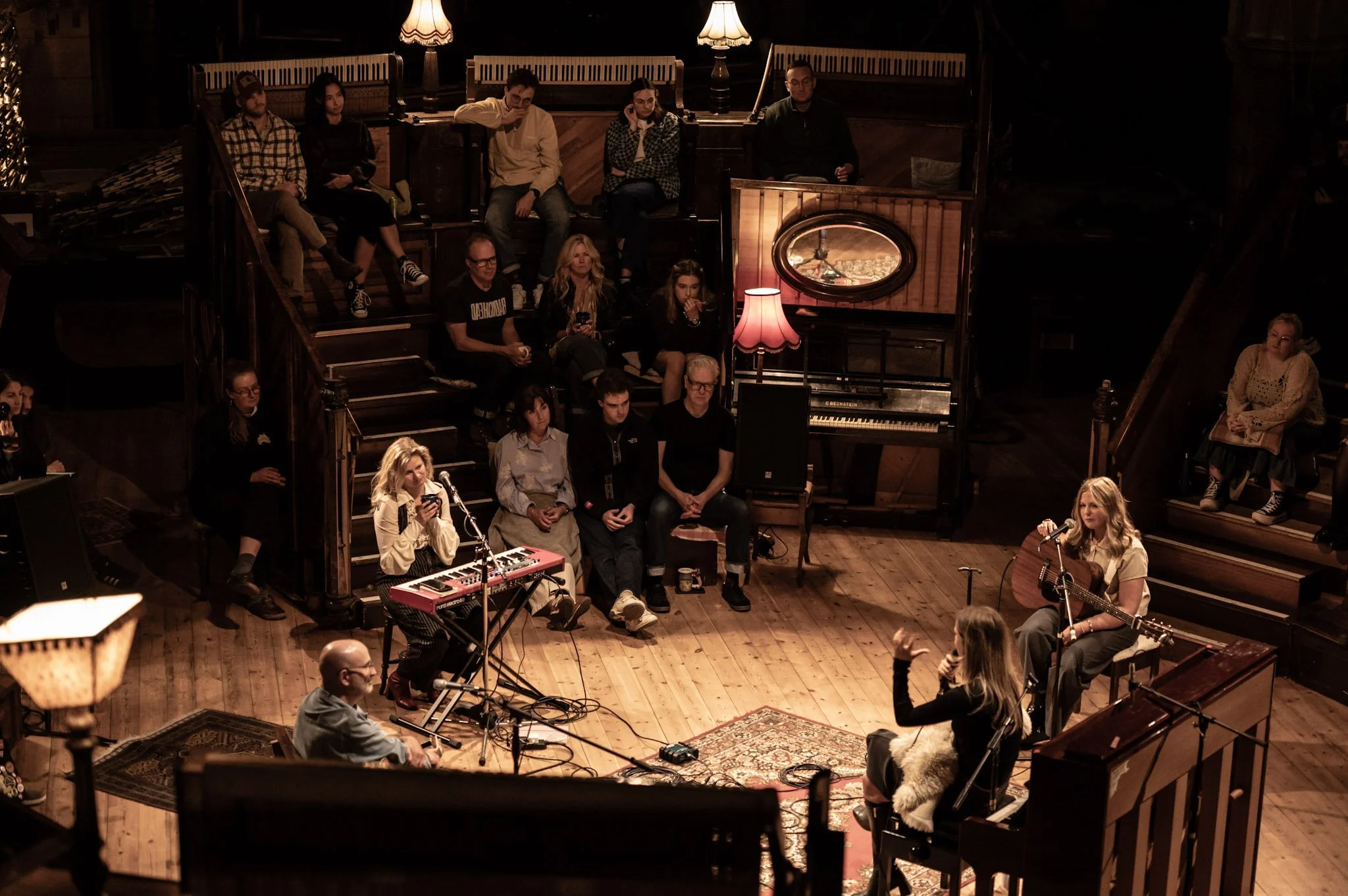
Writer’s Round at the Pianodrome during Edinburgh Fringe ‘26 photo by India Hunkin
Knowing why an artist or songwriter has written a song is usually to the discretion of the person delivering the performance. It’s not mandated, it’s not required, and until the recent social-media fueled phenomenon of personalising content, needing to bare all to be understood in the pursuit of being relatable, I would argue I’ve not known much about the people behind my favourite songs.
I’ve always been an artist who loves to talk. In some ways it’s carried me more than the vocal or instrumental performance itself, and it’s certainly a reason why people have come back to my shows. What on earth is going to come out of my mouth? I don’t know either by the way, I am fortunate my brain works faster than my mouth, and it’s out before I even know what I’ve said. A blessing on stage. Sometimes a curse on reflection.
But some of my favourite artists barely talk on stage. Their music, their performance, their playing, carries them all the way into my re-booked ticket. I recall Novo Amor at the Queen’s Hall in Edinburgh years ago; a pindrop, my eyes closed, 1 hour later, and not a spoken word. There is no right way.
Part of why I talk on stage is to maybe subconsciously dismantle the hierarchy that inevitably exists between performer and audience. We are often higher up, physically raised on a platform, a barrier often separates us. You listen, I play. Sometimes that unspoken contract is broken, but on the performers’ terms. We ask you to raise your hands, to sing along, but we tell you when to start, when to keep going, and when to stop. But what if a format exists that aims to break some of these performance norms? To rebalance the formulaic and familiar status quo of a gig in a way that asks you to know us on a deeper level, even respond, and to take away as much as we give; where talking and playing are equals.
I discovered a Nashville-based phenomenon called ‘writers’ rounds’ a good few years ago, and had the privilege of attending some myself in Nashville last year. 4 songwriters sit in a circle or ‘round’, and each take it in turns to tell the stories behind the songs they have written, before playing the song itself. Sometimes the story takes double the amount of time to tell as the song does to play. The other writers’ are encouraged to improvise along with a song they may or may not have heard before. Meaning, the version of the song the audience gets is always acoustic, as close as it can get to how it was originally written. They are given additional context that they wouldn’t get at a traditional gig; the time allocated to telling the story is equally as worthy as the performance. It is deeply introspective. You then place that format in a space that is designed in such a way that the audience can see you from all angles: your back, your face, your side profile, and you’re no longer looking down on a sea of people, but your personal stories are perceived from all angles, with no place to hide from truth, the core of songwriting; enter, the Pianodrome, Edinburgh.
A ‘radical reimagining of the piano in today’s throw away culture’, I trialed the writers-round format in the Pianodrome for the first time in March this year, with three local Edinburgh-based musicians. It is not just the structural set-up of the Pianodrome that makes it the perfect host for the rounds, a circular pursuit of truth, but the philosophy behind its existence: appreciating the story behind something, a piano, that would otherwise have been discarded. I view songs the same. An artist may record a song, it doesn’t mean they’ve written it. The real story behind the song may get lost, or in some instances discarded. A writers’ round centers it, and allows that story to be told. It recycles the story behind the song by giving it a stage it didn’t have before.
I would need to write another piece on why the ability for songwriters to play live is also critical to their livelihoods in the age of streaming and AI, and I’m only 4 years into my journey as a published songwriter so certainly not the most qualified by any means to tell that story. But one component of the worth of a writers’ round to songwriters is simply this: a space to tell a story, and be heard, from all angles.
The worth of the round to artists is slightly different. Many artists are songwriters also; however, they exist in a different mindset to people who solely write songs in the industry. We often have the pressure to be perfect for an audience, beyond writing the song in the room. Not only is the song the product, nothing exists without the song, but we are also the product itself. We are the vehicle by which the song can be sold, bought, streamed, and licensed. The writers’ round allows the artist to be messy again, without the need to sell their brand. They can trial new material, without needing to conform to a certain production-level. Of course, some artists will never conform to these expectations, but a lot of us do, even subconsciously.
For the audience, the worth of the round is not only to experience something different, something long-form; not a 50-minute fringe show, but a 2 hour one, but a chance to leave inspired. That is the overwhelming sense of feedback I’ve received from hosting these rounds in Scotland and the North East of England over the past 12 months. “I want to pickup my cello again.” “I’ve written down some of things you all said, and I’m going to write some thoughts/lyrics down on the bus home” “My daughter now wants to write songs,because it might make her feel happy.”
Part of the performer/audience contract is broken at a songwriters’ round; when allowed an insight into the process, there is a realisation: you can absolutely do this too. There is no hidden mystery to songwriting for me. It’s the empowerment to tell the truth, and set it to something that could melodically represent that truth. That combination is powerful, and can be done to varying degrees of musical proficiency, but the concept is universally accessible. However, if a song is always represented in a way whereby you can only receive it from a lower position (stage vs. audience seats), and the insight into the process is part of a formulaic introduction, rather than a deeper introduction free from the confines of time restrictions, it always remains a mystery, rather than something you can do. And you can do it.
The Pianodrome operates in a similar way. You can adopt a piano from their open-access Granton showroom. You can freely attend their piano sharings, or wander into their new Bruntsfield home and play the pianos freely. You can watch a writers’ round by sitting on the seat of a recycled piano. You won’t be in and out with 10 minutes to spare. You’ll be there for a long time. But everything worthwhile always takes time. And that is the songwriters’ and the Pianodrome’s, journey.
The final Writers’ Round takes place on Friday 28th of August at the Pianodrome, Edinburgh, with an emphasis on platforming local writers’ Cathal Murphy and Brodie Barclay, and welcoming songwriter Nina Sundstrom, hosted by Eve Simpson.